

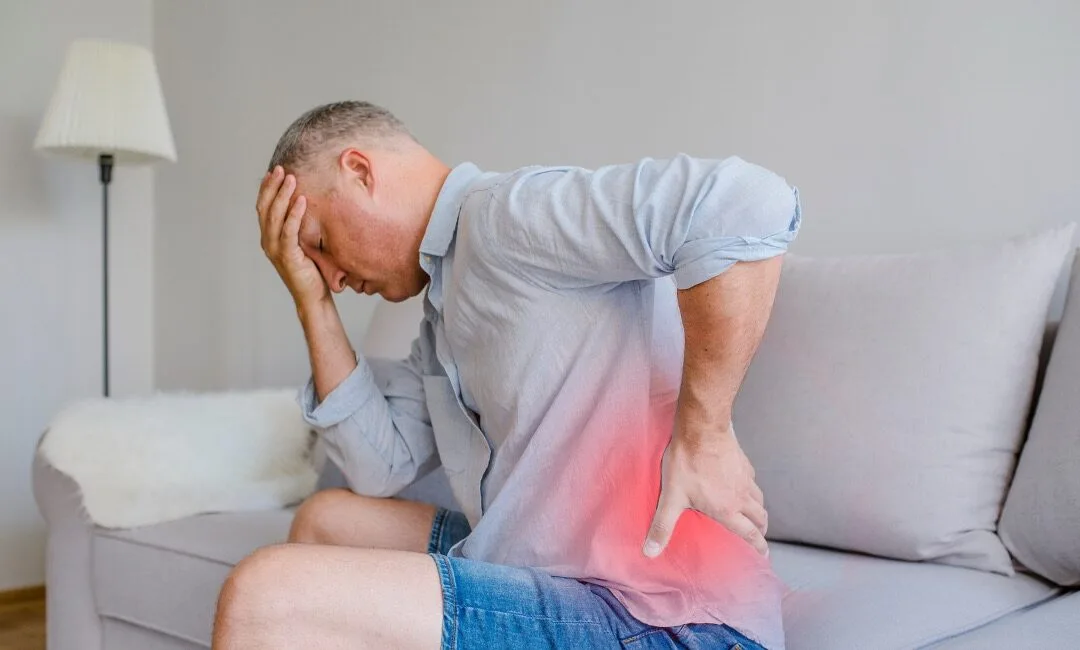
The moment Tom knew something was genuinely wrong, he was standing in his driveway in Bedford trying to carry two grocery bags from the car.
He made it four steps.
The pain that shot down his left leg dropped him to one knee on the pavement. Not the familiar ache he had been managing for months, the one he blamed on long hours at his desk and not enough stretching. This was electric. Sharp and specific and traveling all the way to his foot, which had begun, over the past few weeks, to feel like it wasn’t entirely his.
He sat on the front step for a long time before he went inside.
What a Compressed Disc Does to a Person
The MRI showed what his orthopedic specialist in Woburn described as significant disc compression at L4-L5. The disc was pressing on the nerve root. That pressure was the source of the shooting pain, the numbness, the tingling that had begun waking Tom up at three in the morning. The diagnosis had a name: lumbar radiculopathy. Disc compression causing neuropathy.
His doctor was direct. Physical therapy first. Anti-inflammatory medication. If things didn’t improve in three months, they would talk about injections. After that, possibly surgery.
Tom did the physical therapy. He did it faithfully, twice a week for fourteen weeks, driving in from Bedford to a clinic in Waltham. He took the medication. He bought a standing desk. He stopped running, which had been the thing he looked forward to most after long days working remotely.
The numbness in his foot did not improve.
It spread.
By the time he hit the six-month mark, the tingling had settled into his calf and the bottom of his foot in a way that felt permanent. He had begun unconsciously favoring his left side when he walked, which was creating new problems in his hip. His sleep was fragmented. His concentration at work had slipped. He was irritable in ways he didn’t entirely recognize in himself.
“I kept waiting for the thing that was supposed to help to help,” he said. “And every appointment ended with let’s give it more time.”
His orthopedic team in Woburn remained attentive. Nobody dismissed him. But the options on the table were the same options that had been on the table for half a year, and Tom was running out of patience for waiting.
What His Brother Kept Saying
His younger brother had been a patient at Acupuncture & Wellness Clinic in Burlington for almost a year, coming in from Billerica for a shoulder condition that had stopped responding to conventional treatment. He mentioned Dr. Min Jeon to Tom several times over the course of the summer.
Tom resisted. He was not opposed to acupuncture philosophically, but he was tired. Tired of appointments, tired of explaining his history from the beginning, tired of hope that went nowhere. He told his brother he would think about it.
He thought about it for two more months before he called.
His first appointment with Dr. Min was not what he expected. She had clearly reviewed what he sent ahead of time, but she asked him to walk her through the progression in his own words. She was interested in the specifics: where exactly the tingling lived, whether it was constant or intermittent, what made it better and what made it sharpen. She asked about the sleep. She asked how long it had been since he ran.
She explained what she was seeing in plain language. With disc compression causing neuropathy, the nerve itself becomes irritated and inflamed over time. The body responds by tightening the surrounding musculature, which increases pressure, which sustains the nerve irritation. It becomes a cycle that imaging alone doesn’t always capture. She described a treatment approach that worked on the nerve inflammation directly and on the muscular patterns that had built up around it. She also introduced ATP Resonance BioTherapy®, a low-level electrical frequency treatment that targets inflammation at the cellular level and supports nerve repair.
Tom left the appointment more informed than he had been in months. He was still skeptical. He scheduled the next visit.
The Morning He Ran Again
Ten weeks into treatment, Tom laced up his running shoes for the first time since the previous winter.
He did not go far. A slow two miles through his neighborhood in Bedford, careful and deliberate. But he finished. And the foot that had been numb and unreliable beneath him felt, for the first time in nearly a year, like it belonged to him again.
The tingling was not gone entirely. But it had pulled back considerably, retreating from his calf to a smaller, quieter zone near his heel. His sleep had steadied. He was no longer favoring his left side.
At his next orthopedic appointment in Woburn, his specialist noted the improvement in his gait and asked what had changed. Tom told him about AWC. His doctor reviewed the approach, nodded, and told him to keep going.
Tom still works with his orthopedic team. He has not ruled out an injection if the remaining symptoms plateau. But for the first time since that morning in his driveway, he is not building his life around what his back will and won’t allow.
For anyone in the Greater Boston area living with disc compression, nerve pain, or neuropathy that hasn’t responded the way it was supposed to, his experience is worth a phone call.
If disc compression or neuropathy has been limiting your life and conventional treatment hasn’t been enough, Dr. Min Jeon is ready to help. Call Acupuncture & Wellness Clinic at 781-221-0162 or schedule online at awclinic.com.
Acupuncture & Wellness Clinic | Burlington, MA | Serving Greater Boston including Bedford, Woburn, Waltham, Billerica, and Lexington | Specializing in disc compression, neuropathy, lumbar radiculopathy, and chronic nerve pain for over 25 years.